As visitors step into the Assembly Room at Independence Hall in Philadelphia, they stand where American history changed forever. It was here, 250 years ago this week, that a group of determined delegates challenged the most powerful empire of the age. During the sweltering summer of 1776, men including John Adams, Benjamin Franklin, and Thomas Jefferson debated, revised, and ultimately approved a bold declaration that severed the colonies’ ties with the British Crown. Although the Declaration of Independence is dated July 4, 1776, it took nearly a month before all 56 members of the Second Continental Congress formally signed it.
Standing before green-covered tables arranged with books, letters, pipes, and candles, National Park Service ranger Maggie Burkett reminded a group of visitors of the gravity of that decision.
“These words on this page are treason,” she explained. “By signing this document, you were risking your life. The 56 men who signed it were incredibly brave. In my opinion, they were heroes.”
America’s 250th anniversary could have been a rare moment of national unity. Instead, the semiquincentennial arrives at a time of deep political division, cultural conflict, and uncertainty about the country’s future.
“There’s a sense of dread,” said Eddie Glaude, author of America, U.S.A.: How Race Shadows the Nation’s Anniversaries. “It feels like the celebration is going to descend into myth-making instead of meaningful reflection.”
Two hours south in Washington, D.C., preparations for the anniversary have become closely associated with President Donald Trump. Critics argue that what should have been a bipartisan national celebration has instead taken on the appearance of a political spectacle.
Trump, who has long anticipated celebrating America’s 250th birthday during his second term, launched an initiative to beautify the nation’s capital, restoring monuments, cleaning statues, and repairing neglected fountains. He also proposed constructing a triumphal arch larger than Paris’s Arc de Triomphe.
One of the administration’s highest-profile renovation projects, however, became an embarrassment. A $14.7 million overhaul of the Lincoln Memorial Reflecting Pool—completed through no-bid contracts awarded to companies with previous ties to the president—quickly ran into problems. Within days, algae turned the water bright green, while the pool’s newly applied “American flag blue” coating began peeling away. Trump blamed alleged vandals and threatened legal consequences.
The anniversary celebrations took on an even more partisan tone earlier this month. On June 14, which coincided with Trump’s 80th birthday, the White House South Lawn hosted Ultimate Fighting Championship events. Days later, Trump officially launched the Great American State Fair on the National Mall—an event many observers described as resembling a campaign rally after several originally scheduled performers withdrew over concerns about its political nature.
Transportation Secretary Sean Duffy criticized “those libtards that cancelled on us” while calling Trump “the greatest president since George Washington.” The event featured military flyovers, Trump’s signature dance to the Village People’s “YMCA,” performed alongside the U.S. Marine Band, and concluded with familiar “Make America Great Again” messaging. No Democratic leaders participated.
The state fair continues for 16 days, featuring exhibits from all 56 states and territories, although several declined to send official delegations because of concerns over the event’s political direction. Reviews have been mixed, with some describing sparse attendance and technical issues, including power outages affecting the Ferris wheel on opening day.
July 4 will feature another “Salute to America” celebration led by Trump, including an attempt to set a Guinness World Record for the largest fireworks display. Later this summer, Washington will host the inaugural Freedom 250 IndyCar Grand Prix.
Many of these events emerged after America250, the bipartisan commission established by Congress more than a decade ago, found itself overshadowed by Freedom 250, a Trump-aligned initiative. America250 has focused on more traditional commemorations, including a nationwide time capsule, student essay contests, and an “America’s Block Party” concert featuring Queen Latifah, Chris Stapleton, and The Smashing Pumpkins.
For many historians and observers, the anniversary has become less a celebration of American democracy than a reflection of the nation’s current political divisions.
David Blight, a Yale University historian, expressed little enthusiasm for the festivities.
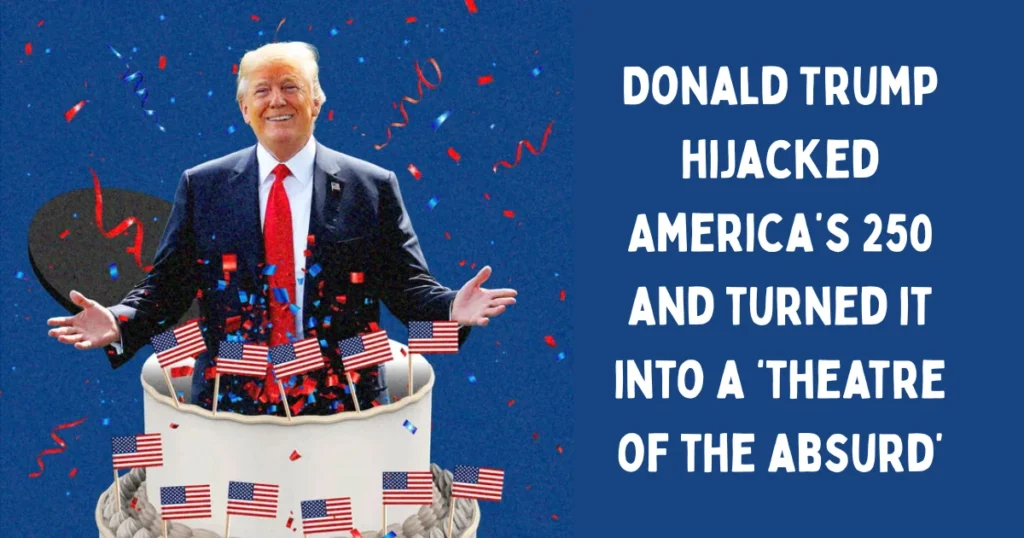
“I don’t feel celebratory at all,” he said. Comparing Trump’s building projects to those of Benito Mussolini, Blight described the president’s vision as “theatre of the absurd.”
Others contrast today’s atmosphere with the country’s bicentennial celebration in 1976. That year featured a parade of tall ships in New York Harbor, the opening of the Smithsonian National Air and Space Museum, and nationwide festivities that largely avoided becoming centered on President Gerald Ford.
Harvard historian Jill Lepore argues that today’s political climate has made even nonpartisan celebrations difficult.
“To celebrate the nation’s birthday shouldn’t be interpreted as endorsing whoever happens to be in the White House,” she said.
Public opinion reflects that unease. A recent Reuters/Ipsos survey found that 38% of Americans—including 40% of Democrats and 26% of Republicans—do not believe the United States will remain a single country 250 years from now. Nearly two-thirds also believe American democracy is at risk.
Even some conservatives express disappointment that the anniversary has failed to become a unifying national event.
Bill Whalen of Stanford University’s Hoover Institution said the country’s 250th birthday should have resembled the famous Christmas Truce of World War I—a brief pause in political conflict that allowed Americans to come together despite their differences.
Whalen argued that the outcome of the 2024 presidential election ultimately shaped how the anniversary would be remembered. He suggested that a Kamala Harris presidency might have emphasized America’s history of slavery and inequality, while Trump’s approach instead raises questions about style, excess, and political personalization.
As America approaches one of the most significant milestones in its history, the contrast is striking. The courage and shared purpose that defined Independence Hall in 1776 stand in sharp contrast to a modern celebration overshadowed by polarization, competing historical narratives, and political spectacle. Rather than serving as a moment of national unity, the nation’s 250th birthday has become another reflection of the deep divisions shaping contemporary America.